Post-3.15 Reflection: Why Governance Still Fails to Stop the "Bad Money" from Winning?
Lead-in: Every year, the "3.15 Gala" (World Consumer Rights Day) serves as a grand spectacle of "spectator-style law enforcement." However, when the spotlights dim, do the banned accounts and shuttered stores truly address the deep-rooted causes of the issue? This article attempts to deconstruct three major logic risks in governance behind this annual frenzy: Why have credentials become a shield? Why is innovation used as a cloak for fraud? And why do we constantly fall into a trap of over-reliance on regulation?
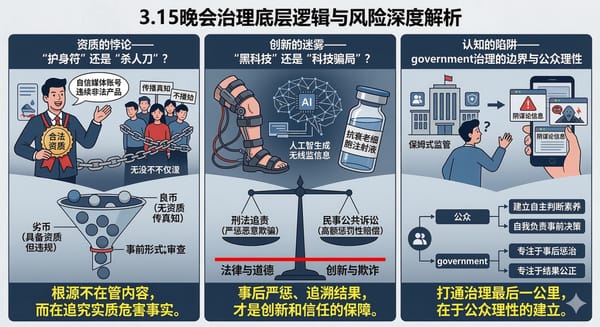
I. The Paradox of Credentials: When the "Amulet" Becomes the "Blade"
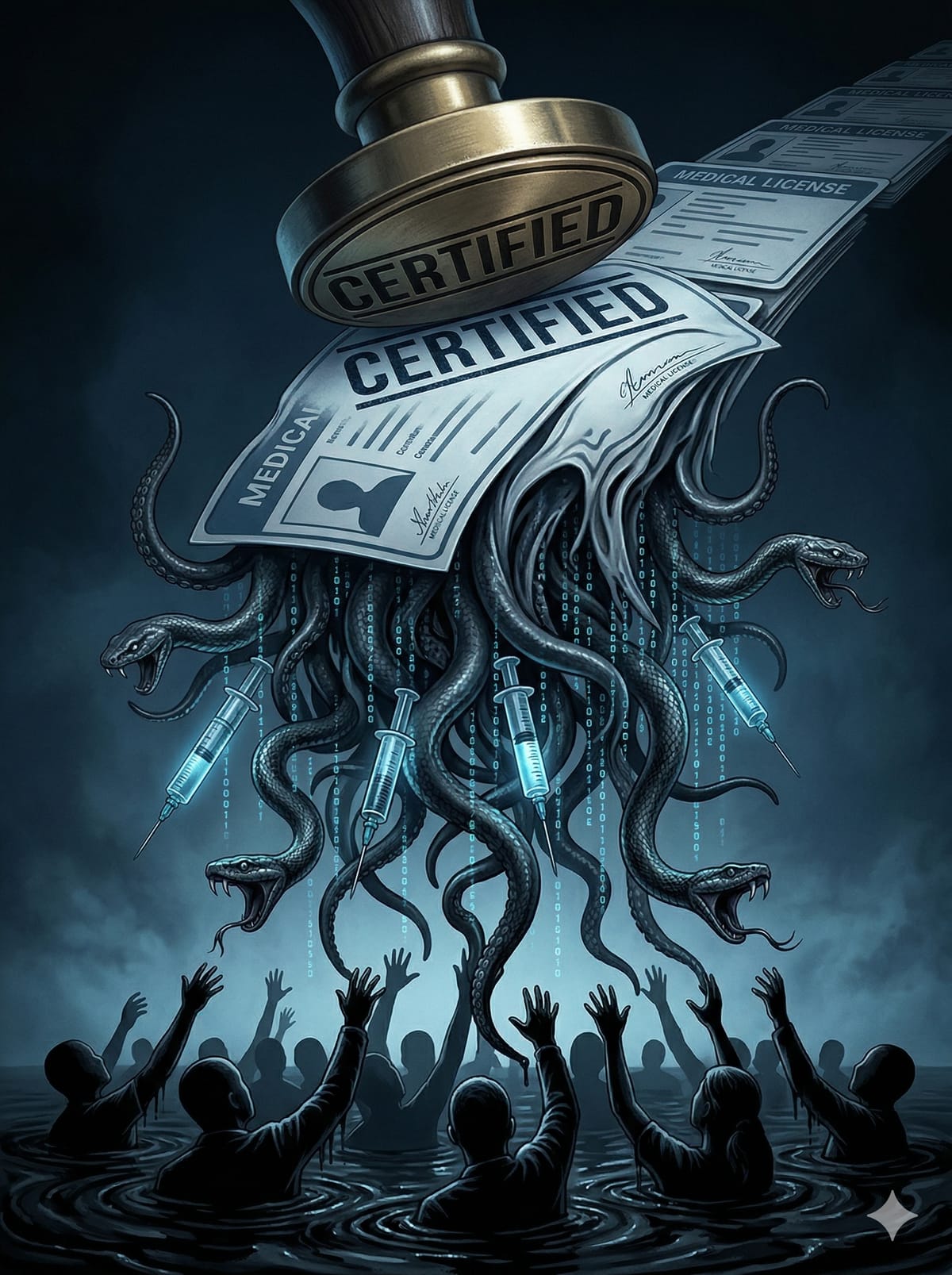
In this year’s 3.15 cases, we see a familiar script: a self-media account dons the mantle of a "medical expert" to peddle illicit products within private traffic pools.
Governance Logic Risk: Current regulatory paths rely heavily on ex-ante (preliminary) credential audits. Platforms demand a medical license before one can post health science videos. While this sounds ideal, the reality is harsh: the groups committing large-scale violations are often those who actually possess the relevant credentials. They use these credentials to bypass scrutiny, producing illicit content en masse under a "compliant" identity to harvest traffic.
The cost is evident: individuals with genuine professional ethics and scientific knowledge may be barred by cumbersome certification processes, while credentialed violators strike gold under the logic of "bad money driving out the good."
Core Viewpoint: The root of governance should not be the priori regulation of content, but rather penetrative accountability for substantive harm. If a credentialed individual commits a criminal offense or civil fraud, they should be prosecuted under criminal and civil law directly, rather than merely having an account revoked.
II. The Mists of Innovation: "High-Tech" or "High-Tech Scam"?
From "black tech" for physical height enhancement to AI-generated garbage content in the GEO field, to in-vitro cell injections claiming to reverse aging—the cases exposed by 3.15 invariably wrap themselves in the tiger skin of "technological innovation."
Governance Logic Risk: Current law enforcement faces a massive dilemma: the blurring of boundaries between criminal and civil domains, and between law and morality.
- Is this criminal fraud or a civil contract dispute?
- Are these products completely ineffective, or "potentially effective yet potentially harmful"?
If we implement extremely rigid ex-ante regulation, we risk stifling genuine scientific innovation. Yet, if we remain completely hands-off, enterprises will act recklessly within the vacuum of "evidence-based medicine."
The Ideal Governance Solution: Rather than setting up multiple roadblocks beforehand, it is better to strengthen the intensity of public interest litigation after the fact. For subjective malicious deception involving criminal elements, processing must be swift and severe. For civil breaches, the cost of violation must be raised significantly so that enterprises vanish entirely through "bankruptcy of trust."
III. The Cognitive Trap: Where Are the Boundaries of Government Governance?
The most thought-provoking case involves "cell injections." Even after official warnings regarding the risks, many consumers would rather believe conspiracy theories—such as "the state is blocking this technology to reserve it for the elite"—than accept that they are being swindled by unlicensed institutions.
Governance Logic Risk: The loss of public rational judgment is creating a massive hurdle for governance. Driven by the instinct to "seek gain and avoid harm," many have developed "Government Dependency Syndrome"—simultaneously demanding the government control everything while harboring deep-seated skepticism toward authoritative information.
We must clarify the boundaries of governance:
- The Government’s Duty: To ensure procedural justice, punish violations severely after the fact, and maintain the fairness of outcomes.
- The Public’s Duty: To establish information literacy for independent judgment.
Warning: If the public does not take responsibility for their own preliminary decisions, "nanny-style" regulation will only provide more channels for conspiracy theories. The "last mile" of governance can only be cleared when every individual maintains a logic of rational judgment.
Conclusion
The 3.15 Gala should not just be an annual "blacklist"; it should be a mirror reflecting the misalignments in our governance logic.
If regulators only look at the "signage," scammers will simply buy a sign. If enforcement only focuses on "attitude" rather than "consequences," fraud will simply change its shell and be reborn. The future of governance lies in shifting from "managing identity" to "managing behavior," and from "preliminary blockades" to "post-hoc traceability."
Only then can we escape the cycle of "annual exposure, annual rebirth."
Interactive Topic: What do you believe is the most effective punishment for credentialed violators? Feel free to share your views in the comments.