Tencent's AI Agent Strategy: Sitting on a Gold Mine, Digging in the Dirt
— On the "Defensive" Dilemma of Tencent's Agent Ecosystem and the Three-Step Breakthrough Path
Introduction: When the "Crawfish" Collides with the "Penguin"
In early 2026, the AI Agent sector witnessed a sudden paradigm shift. The explosive popularity of the open-source project OpenClaw (affectionately known in China as "Xiaolongxia" or Crawfish) forced Tencent into a rapid response: releasing QClaw for WeChat, WorkBuddy based on CodyBuddy, and a one-click deployment solution via Tencent Cloud.
However, this seemingly efficient "Big Tech response" stirred a hornet's nest in the developer community. From the criticisms of OpenClaw’s founder to grievances regarding "SkillHub" and its forced redirection of traffic, a deep structural contradiction has been exposed: In the era of AI Agents, Tencent is still attempting to use the "closed moat" mentality of the mobile internet era to fence in an ecosystem that is inherently designed to be open.
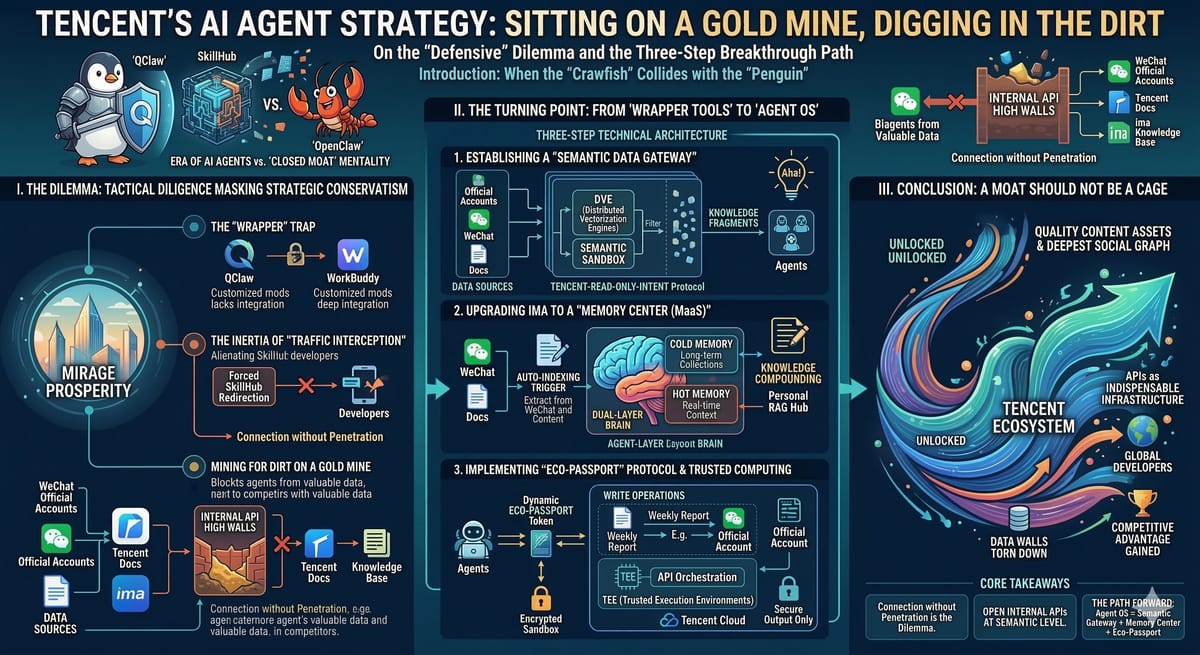
I. The Dilemma: Tactical Diligence Masking Strategic Conservatism
Tencent's current Agent layout represents a form of "mirage prosperity":
- The "Wrapper" Trap: Products like QClaw and WorkBuddy are largely customized modifications of existing OpenClaw architectures. These "fast-food" style products can quickly occupy desktops, but they lack the unique internal resource support required for a true intelligence breakthrough.
- The Inertia of "Traffic Interception": Forcing users into a self-built SkillHub is essentially a secondary interception of open-source fruits. This move not only alienates developers but also reflects Tencent’s acute anxiety over losing its position as the primary traffic gateway.
- Mining for Dirt on a Gold Mine: Tencent possesses world-class content assets: WeChat Official Accounts, Video Accounts, Tencent Docs, and the ima Knowledge Base. Yet, due to internal API "high walls," current Agents cannot even retrieve articles from the accounts a user follows. This internal silo prevents Tencent's Agents from leveraging their true strength in the face of competition from ByteDance’s Doubao or Alibaba’s Tongyi.
II. The Turning Point: From "Wrapper Tools" to "Agent OS"
To win, Tencent should not be patching code on the surface; it needs "structural surgery" at the architectural level. Tencent's real advantage lies in the seamless orchestration of Agents across its entire ecosystem.
To achieve this, we propose a Three-Step Technical Architecture designed to tear down the walls and release the ecosystem dividend:
1. Establishing a "Semantic Data Gateway"
- Goal: Achieve "Semantic-level" openness rather than just simple interface access.
- Architectural Logic: Deploy Distributed Vectorization Engines (DVE) at the base layer of Official Accounts, WeChat, and Docs.
- Implementation: Introduce the Tencent-Read-Only-Intent protocol. When an Agent accesses data, the gateway returns knowledge fragments or summaries processed via a Semantic Sandbox, rather than raw full-text files.
- Value: Resolves security concerns while allowing Agents to penetrate Tencent’s content moat, making them the most knowledgeable assistants in the Chinese-speaking world.
2. Upgrading ima Knowledge Base to a "Memory Center (MaaS)"
- Goal: Transform ima from a static bookmarking tool into a dynamic brain for Agents.
- Architectural Logic: Adopt a Dual-Layer Memory Architecture (Cold Memory for long-term storage of all collections; Hot Memory for real-time interaction context).
- Implementation: Build an "Auto-Indexing Trigger" to realize real-time semantic slicing of content from WeChat and Docs into ima.
- Value: Creates a unique personal RAG (Retrieval-Augmented Generation) hub. Users can invoke years of their own reading history through an Agent, achieving "Knowledge Compounding."
3. Implementing the "Eco-Passport" Protocol and Trusted Computing
- Goal: Enable automated "Write Operations" across products while protecting privacy.
- Architectural Logic: Introduce the Eco-Passport—a dynamic token mechanism—to replace simple, static OAuth authorizations.
- Implementation: Utilize TEE (Trusted Execution Environments). Complex Agent tasks (e.g., auto-summarizing a weekly report and publishing it to an Official Account) run within encrypted sandboxes on Tencent Cloud. Data never leaves the internal network; only the result is output.
- Value: Allows Agents to securely orchestrate Tencent services via APIs, forming a genuine application ecosystem.
III. Conclusion: A Moat Should Not Be a Cage
Tencent owns the highest quality content assets and the deepest social graph in the Chinese internet. If it maintains its current closed nature, these resources will eventually become "dead assets."
True leadership does not come from funneling developers into a proprietary SkillHub, but from making Tencent's APIs the indispensable infrastructure for the global Agent developer community. The day Tencent dares to tear down its internal data walls will be the day its AI Agents truly gain a competitive advantage.
Core Takeaways:
- Tencent’s Agent dilemma is "Connection without Penetration."
- Internal service APIs (WeChat, ima, Docs) must be opened at a semantic level.
- The path forward: Semantic Gateway + Memory Center + Eco-Passport to reconstruct an Agent OS.