Professor Tang Jie: The National Unified Market Is Shenzhen’s Greatest New Opportunity After the Special Zone Policy
Recently, Professor Tang Jie was invited to deliver a keynote speech on new strategic opportunities.
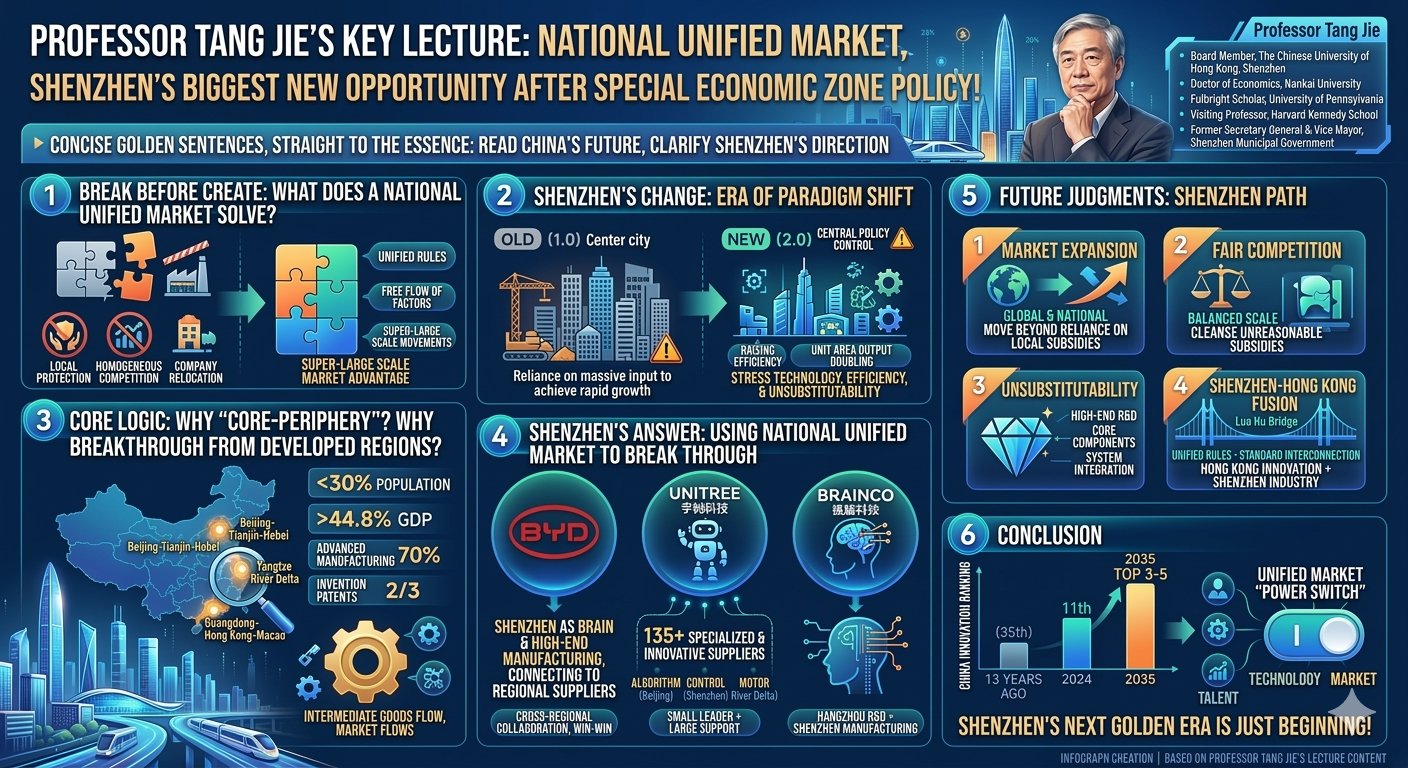
As a respected economist and former Shenzhen leader, Professor Tang Jie is a member of the Board of Directors of The Chinese University of Hong Kong, Shenzhen, holds a bachelor’s, master’s and doctoral degree in economics from Nankai University, is a Fulbright Scholar at the University of Pennsylvania and a visiting professor at the Harvard Kennedy School. He has also served as Secretary-General of Shenzhen Municipal Government, Vice Mayor, and Vice Director of the Standing Committee of Shenzhen Municipal People’s Congress.
With clear and incisive insights, he interpreted the in-depth logic between the national unified market and Shenzhen’s high-quality development.
- What the Unified Market Really Wants to Solve
Professor Tang pointed directly to a core pain point:
local “small cycles” have fragmented China’s huge market.
• Regions pursue self-contained industrial chains, poach enterprises, and adopt subsidies that distort market prices
• Severe overcapacity, homogeneous competition, and companies constantly relocating for preferential policies
• China’s enormous economic potential is weakened by administrative barriers
The essence of the unified market:
Not centralized planning, but unified rules, breaking local protectionism, and free flow of production factors.
It means shifting from heavy reliance on exports to strong domestic circulation—where Shenzhen products go to Shanghai, and Shanghai products come to Shenzhen.
- Shenzhen’s Transformation: From Building Space to Raising Efficiency
In 45 years, Shenzhen built about 1.1 billion square meters of buildings, driving rapid growth through large-scale investment.
Today, the model has fundamentally changed:
• High-density development is restricted; buildings above 20 stories face limits
• Construction growth will slow; future growth depends on higher output per square meter
• Shenzhen is moving from “expanding scale” to “improving quality, efficiency, and irreplaceability”
Professor Tang’s judgment:
The national unified market is the most favorable national policy for Shenzhen since the end of special zone preferences.
- Core Logic: Core-Periphery Structure & Advanced Regions Lead
The unified market does not mean uniform development. It follows a core-periphery pattern:
- Pioneer in advanced core regions
The three major city clusters — Beijing-Tianjin-Hebei, Yangtze River Delta, and Guangdong-Hong Kong-Macao Greater Bay Area — account for less than 30% of national population but over 44.8% of GDP, 70% of advanced manufacturing, and two-thirds of invention patents. - The bottleneck is intermediate goods
Consumer markets are open, but parts, materials, and equipment face the strongest regional barriers. Intermediate goods make up more than 70% of industrial output. - Finer division = larger market = less involution
Involution = homogeneity and price wars.
Breakthrough = specialization and irreplaceability.
Shenzhen’s strength in electronics comes from extreme division of labor and close regional collaboration. - Shenzhen’s Path: Irreplaceability, Not Subsidies
Professor Tang used three classic cases to show Shenzhen’s strategy:
① BYD: Cross-region collaboration, not relocation
BYD expanded heavily in the Yangtze River Delta, but Shenzhen remains the core of R&D and key components.
• Shenzhen: brain and high-end manufacturing
• Yangtze River Delta: precision processing and supporting industries
• Cross-region cooperation turns competition into win-win.
② Unitree Robotics: A small firm leading a national supply chain
A Shenzhen company with ¥1 billion revenue coordinates 135 specialized “little giant” enterprises nationwide:
• Beijing: robot algorithms and systems
• Shenzhen: radar, vision, and control systems
• Yangtze River Delta: high-precision motors, reducers, and components
③ BrainCo: Hangzhou defines problems; Shenzhen solves them
A world-leading non-invasive brain-computer interface company formed a new model:
Hangzhou R&D + Shenzhen manufacturing.
Hangzhou provides top scientists; Shenzhen provides the supply chain and engineers.
- Four Key Directions for Shenzhen
- Shift from investment attraction to market expansion
- Reduce unreasonable subsidies and uphold fair competition
- Build irreplaceable advantages in R&D, core components, and system integration
- Deepen Shenzhen-Hong Kong integration by unifying standards and systems
- Conclusion: The Next Decade Belongs to the National Market
China’s global innovation ranking rose from 35th to 11th in just over a decade, and is expected to enter the top 10 by 2025. The 2035 goal is top 3–5 globally.
The unified market is the key to fully unlocking talent, technology, and market potential.
For Shenzhen:
This is not restriction, but transformation. Not pressure, but the greatest opportunity.
From special zone dividends to unified market dividends, Shenzhen’s next golden era is just beginning.